



Fishing at PHWIN: Aim Better, Spend Smarter, Play Clear
Fishing at PHWIN turns every shot into a small decision. Target value, cannon cost, special fish and firing speed all affect how quickly a balance moves. Understanding those details makes the action easier to follow and helps you avoid spending heavily on a target simply because it looks valuable.
Unlike a slot round that resolves after one spin, Fishing stays active. Creatures move across the screen, weapons can be adjusted while they are moving, and another shot is always tempting. That creates the appeal: You are doing something rather than waiting for a result. It also creates the main risk. A few seconds of rapid firing can represent dozens of separate paid attempts.
Inside Phwin, Fishing makes more sense when you treat ammunition as part of the game rather than background animation. Before chasing sharks, turtles or the biggest creature on screen, know what each shot costs and what capturing that particular target can actually produce.
How Fishing Works
The basic action is easy to pick up. Choose a cannon or bet level, aim at a moving creature and fire. Each shot uses the amount attached to the selected weapon level. If the target is successfully captured, its reward or special effect is applied according to that game’s rules.
The important part is what happens between those simple steps.
Different fish can carry different values. Some special creatures activate features instead of behaving like ordinary targets. Bosses may be linked to reels or larger multipliers. Certain weapons can attack an area rather than a single creature.
So Fishing is not simply:
- Find the largest fish.
- Shoot until it disappears.
- Move to the next large fish.
A better routine is to identify the target, check the current cannon level and consider how much screen time remains before deciding how aggressively to fire.
A large multiplier tells you what a feature may pay. It does not tell you that the next bullet is likely to capture the target.
That distinction matters. It prevents an eye-catching boss from turning into an open-ended chase.
Read the Screen Before You Fire
The Fishing screen is busy by design. Small fish cross behind larger ones, special creatures appear suddenly, and a boss may pull attention away from everything else. Firing immediately at every new target feels natural, but a short scan can save a surprising number of unnecessary shots.
Screen position changes the decision
A creature entering from the side gives you more time to work with than one already approaching the opposite edge. Suppose a valuable fish is almost gone and you have already missed several times. Increasing your firing speed for its final second does not make those earlier shots recoverable. It simply commits more money before the target leaves.
Targets near the center offer more room to decide. You can watch their movement, adjust aim and stop without feeling forced into a last-second burst.
Movement matters too. A slow creature may allow deliberate manual shots. A fast target weaving through several smaller fish can encourage frantic firing, especially when the screen is crowded.
Special fish deserve a second look
Not every unusual creature is just a higher-paying version of a normal fish. Some are connected to bonus effects, reels, area attacks or other mechanics.
Happy Fishing by JILI is a useful example. Its official game information identifies special fish with different functions, including the Gem Turtle and Mega Octopus. The Mega Octopus can activate a bonus reel, while the reel itself can develop into a gold reel.
That changes how you read the screen. The creature is not interesting only because it looks bigger. Its function is different.
Cannon Levels and the Real Price of a Shot
Fishing can make spending feel less obvious than games built around one clearly separated bet at a time. A cannon fires, another fish arrives, then another shot follows. The action barely pauses.
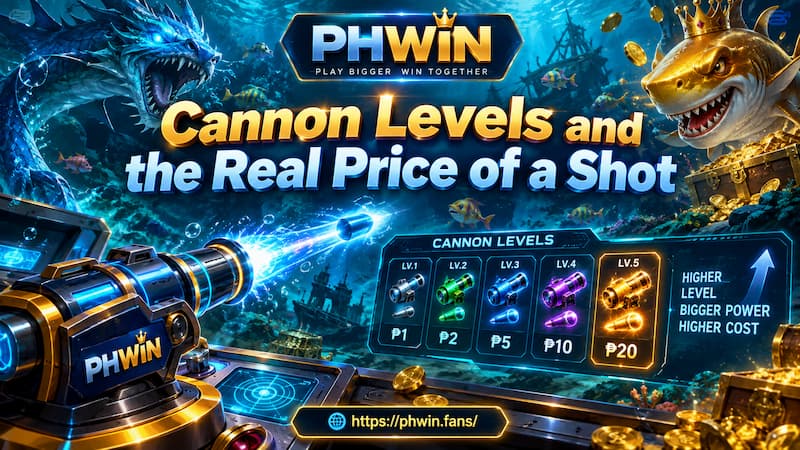
Cannon Levels and the Real Price of a Shot
The simplest way to keep perspective is to separate two variables:
Cost per shot × number of shots = total amount committed.
Imagine a Fishing game where the selected denomination corresponds directly to the following Peso amounts:
- 100 shots at ₱1 each = ₱100
- 100 shots at ₱5 each = ₱500
- 200 shots at ₱5 each = ₱1,000
- 200 shots at ₱10 each = ₱2,000
The visual difference between firing 100 and 200 times may not feel dramatic during a fast session. The difference to the balance certainly is.
Actual denominations should always be checked inside the game before using examples like these as a spending reference. Some Fishing titles display internal bet units rather than a simple Peso-per-bullet figure.
Higher cannon power is not a shortcut
Increasing the cannon can raise the amount placed behind each attempt, but it should not be treated as a guarantee that a stubborn fish is suddenly ready to be captured.
One of the easiest habits to fall into is escalation:
- Several shots miss.
- The target remains on screen.
- The cannon is increased.
- Firing becomes faster.
- The player feels committed because money has already been spent.
The first four shots do not create a debt that the fifth shot needs to repay.
Once that is understood, switching weapons becomes a deliberate choice instead of an emotional response to previous misses.
Happy Fishing and Its Special Targets
Happy Fishing provides a clearer example of how feature-driven Fishing can become. JILI categorizes it as a Fish and Arcade game and lists the Special Octopus Wheel among its main features.
Mega Octopus
Capturing the Mega Octopus can trigger the bonus reel. According to JILI, that reel can evolve into a gold reel with multipliers reaching up to 950x.
The 950x figure is easy to notice, but it should be read correctly. It is the stated upper multiplier connected to the feature, not an indication that every appearance of the Mega Octopus will produce 950x.
That changes the sensible question from “How do I get 950x?” to “How much am I prepared to spend chasing this particular feature?”
The second question is far more useful because it involves something you actually control.
Gem Turtle
Happy Fishing also identifies the Gem Turtle with an 8x Super Prize feature.
Again, target recognition matters. Someone firing without knowing the creature’s function sees only another animated turtle. Someone who has read the feature information understands that it has a specific role.
This is one reason learning one Fishing game thoroughly can be better than jumping between several titles. When you recognize the special creatures, the screen stops looking like random underwater movement.
Small Fish, Special Fish and Bosses
There is no universal target that deserves every shot. Each type creates a different trade-off.
Small Fish, Special Fish and Bosses
Small fish
Smaller targets are useful when you want to understand aiming, movement and firing pace without immediately becoming absorbed in a boss chase. They also create frequent opportunities to decide whether to shoot or simply let a creature pass.
Special fish
These need more attention because their value can come from a triggered mechanic rather than a straightforward reward.
Before spending heavily, check:
- What happens when the creature is captured?
- Is the effect fixed, multiplied or feature-based?
- Does it affect nearby fish?
- Is the displayed multiplier a reward value or part of a separate bonus?
- How much are you currently spending per attempt?
Bosses
Bosses naturally dominate the screen. They are large, visually dramatic and often associated with bigger features.
That is exactly why they can distort spending decisions.
If a boss has already absorbed 20 shots, there is a strong temptation to think stopping now wastes those 20 attempts. In reality, they have already been spent. Shot number 21 should be judged on its own cost and the amount you are still willing to commit.
The sunk-cost trap
Consider a simple situation. You planned to use ₱500 during a Fishing session. A boss appears after you have already spent ₱250. You continue firing because you have “put too much into it to stop.”
Soon the balance allocated for the whole session is concentrated on one target.
Nothing about the previous expenditure requires you to continue. A predetermined stop point can protect the original plan from being rewritten in the middle of the action. Setting that limit before play is also one of the simplest responsible gaming habits to apply when rapid firing makes spending harder to notice.
Auto-Fire Can Change the Pace Quickly
Automatic firing is convenient. It can also make the true pace of betting harder to feel.
Manual firing creates a tiny decision before every shot. Auto-fire removes that pause. The cannon continues while attention moves toward the creatures rather than the balance.
The combination that deserves the most attention is higher cannon value plus rapid automatic fire. Each change may look manageable by itself, but together they can multiply spending speed.
A practical habit is to check three things whenever the action becomes intense:
- Current cannon or bet level.
- Current balance.
- Number of targets you are actively chasing.
If one boss is pulling most of your attention, briefly checking those numbers can prevent a few exciting seconds from becoming an unexpectedly expensive sequence.
Common Fishing Mistakes
Fishing rewards attention more than random button pressing, even though understanding the screen cannot remove chance from the outcome.
Several habits repeatedly create avoidable spending.
Shooting everything that moves
More activity does not automatically mean better play. Filling the screen with bullets can make it difficult to know which target is actually receiving your attention or money.
Chasing creatures at the edge
When a fish is almost gone, the remaining window is short. A last-second burst often comes from urgency rather than a planned target choice.
Raising the cannon after repeated misses
Missed shots are already settled. They do not establish that a capture is “due.”
Reading multiplier values as capture odds
Happy Fishing’s maximum 950x feature value describes potential reward mechanics. It is not a 950x signal telling you when a target will be captured.
Ignoring firing frequency
A relatively modest shot value can still create high total spending when hundreds of shots are fired rapidly.
Choosing a Fishing Game That Fits You
A Fishing title should fit the way you want to interact with the screen, not simply advertise the largest number.
Consider these points before settling into a longer session:
- Controls: Do you prefer manual aiming or automated shooting?
- Feature complexity: Are special creatures easy to recognize and understand?
- Bet range: Does the lower end fit the amount you intend to use?
- Game pace: Can you comfortably follow the targets without firing impulsively?
- Weapon mechanics: Are special guns clearly explained?
- Feature visibility: Can you tell what a boss or bonus creature actually does?
Happy Fishing suits users who like feature-driven targets because creatures such as the Mega Octopus and Gem Turtle have identifiable roles rather than being purely decorative.
JILI’s wider Fishing catalog also illustrates how much mechanics can vary. Mega Fishing, for example, includes torpedoes and a railgun alongside its Special Octopus Wheel. That is a useful reminder not to assume controls learned in one title transfer perfectly to another.
- View more: How to Form Valid Melds in Tongits