



How Blackjack Switch Changes the Standard Game
Blackjack Switch Rules change the normal blackjack sequence by giving you two equal wagers, two starting hands, and one chance to exchange cards. The key is knowing when switching helps, how dealer 22 is settled, and which table rules must be checked before play.
Blackjack Switch Rules at a Glance
Blackjack Switch still feels familiar once the hands begin, but the opening phase changes the game completely. Instead of receiving one hand, you start with two hands and place an equal wager on each.
If you want to bet PHP 100, for example, you normally place PHP 100 on the first hand and PHP 100 on the second. Your total opening stake is therefore PHP 200.
After the initial deal, you receive one extra decision that standard blackjack does not offer: You may exchange the second card of one hand with the second card of the other.
That sounds simple, yet it can turn two awkward hands into two strong ones.
Two Equal Bets and Two Starting Hands
Each betting position produces two separate blackjack hands. They share the switching decision at the beginning, but after that they are played and settled individually.
The usual sequence is:
- Place two equal wagers.
- Receive two cards on each hand.
- Check the dealer’s exposed card.
- Decide whether to switch the second cards.
- Play each hand normally.
- Settle each wager separately.
You cannot shift any card you want. Only the second card dealt to each original hand can be exchanged.
The Second-Card Switch
Consider this deal:
- Hand A: 10 + 6
- Hand B: 5 + 10
Keeping the cards gives you 16 and 15, two uncomfortable totals.
Switching the second cards produces:
- Hand A: 10 + 10 = 20
- Hand B: 5 + 6 = 11
That is the appeal of Blackjack Switch in one deal. One decision changes the structure of both hands at the same time.
Switching Is Optional
A switch is never automatically better. If the original hands already work well against the dealer’s upcard, keeping them may be the stronger choice.
You are not trying to create the prettiest single hand. You are trying to improve the combined position of both wagers.
The Order of Play
The switching decision happens before ordinary blackjack decisions, which makes the sequence important.
Once both hands are dealt, compare the original arrangement with the possible switched arrangement. Only after choosing between them do you begin hitting, standing, doubling, or splitting.
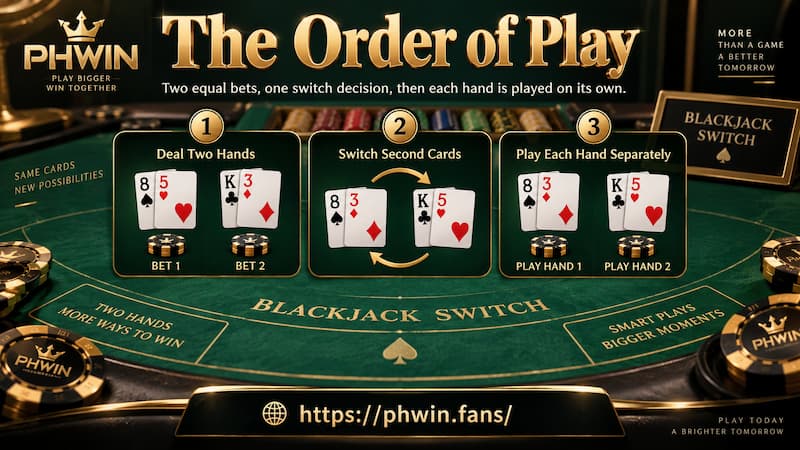
The Order of Play
Playing Each Hand After the Switch
After the cards are locked into place, the two hands operate separately.
Depending on the table rules, the familiar actions can include:
- Hit
- Stand
- Double
- Split
A strong switch can create opportunities that did not exist a moment earlier. Turning a weak total into 11, for instance, may create a useful doubling situation. At the same time, the other hand might become a 19 or 20 that needs no further action.
This two-hand balance is the heart of Blackjack Switch Rules.
Dealer 22 Changes the Outcome
The most important settlement difference appears when the dealer reaches 22.
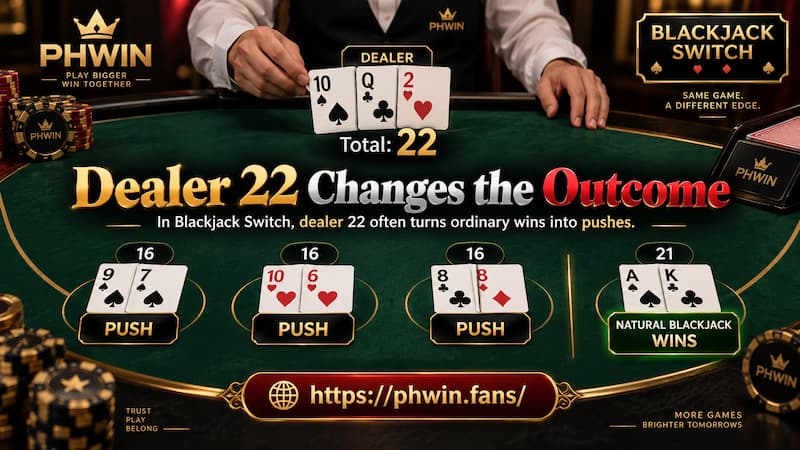
Dealer 22 Changes the Outcome
In ordinary blackjack, a dealer total above 21 is a bust and every surviving player hand wins. Blackjack Switch commonly treats dealer 22 differently: A dealer 22 pushes against surviving player hands instead of losing to them.
Suppose you stand with 20 and the dealer finishes with 22. In standard blackjack, your 20 wins. Under the common Blackjack Switch rule, the wager is returned as a push.
That single rule compensates for the powerful ability to rearrange your opening cards.
Strong Hands Can Still Push
The dealer-22 rule changes the value of totals that normally feel almost untouchable.
A 20 remains excellent, but it is no longer guaranteed to collect a win when the dealer goes over 21. If the dealer lands specifically on 22, that hand may simply be returned.
The same consideration matters after doubling. A doubled hand that finishes strongly can still be pushed by dealer 22 under common rules.
Dealer 22 should not be treated as a normal dealer bust when playing Blackjack Switch.
Natural Blackjack Is Different
An original natural blackjack usually receives special treatment and can still beat dealer 22.
The important word is original. A natural blackjack generally means an Ace plus a ten-value card received together in the initial deal before any switch takes place.
A two-card 21 created by exchanging cards may instead be treated as an ordinary 21.
Because providers can implement details differently, this is one rule worth checking before committing larger wagers.
Blackjack Payouts After Switching
Blackjack Switch gives the player more flexibility at the start, so several payouts are less generous than traditional blackjack.
Natural Blackjack Commonly Pays 1:1
Traditional blackjack often pays 3:2 for a natural blackjack. Blackjack Switch commonly reduces that payout to even money.
With a PHP 500 wager:
- A 1:1 blackjack payout produces PHP 500 in winnings.
- A traditional 3:2 payout would produce PHP 750 in winnings.
That difference is not cosmetic. It is one of the built-in trade-offs for having the ability to restructure two hands before playing them.
Switched 21 Is Not Always a Blackjack
Imagine one hand begins with an Ace and 7 while the other begins with 9 and King.
Switching the second cards can create Ace-King, apparently a perfect blackjack. Under many Blackjack Switch rule sets, however, that switched Ace-King is simply counted as 21 rather than an original natural blackjack.
Original Blackjack
An Ace and a ten-value card dealt naturally to the same starting hand.
Switched 21
An Ace and ten-value card brought together through the switching action.
The visual result is identical, but the settlement can be different.
Blackjack Switch Compared With Standard Blackjack
Most of the basic actions remain recognizable, but the important rule changes happen before the hands are played and when the dealer settles the round.
| Rule | Standard Blackjack | Blackjack Switch |
| Starting hands | Usually one | Two |
| Opening wagers | One main wager | Two equal wagers |
| Card switching | Not allowed | Second cards may be exchanged |
| Natural blackjack | Commonly 3:2 | Commonly 1:1 |
| Dealer 22 | Dealer bust | Usually push |
| Hit and stand | Available | Available |
| Double | Rule dependent | Rule dependent |
| Split | Rule dependent | Rule dependent |
For experienced blackjack players, the dangerous assumption is that familiar hand values automatically produce familiar results. They do not.
Switching Changes Basic Strategy
Standard blackjack strategy begins with one hand against one dealer upcard. Blackjack Switch adds another layer: You must decide how the two hands should be constructed before applying ordinary playing decisions.
Balance Both Hands
Suppose switching can give you one excellent 20 but leave the second hand at 13. Another arrangement might produce 18 and 18.
The first option creates the strongest individual hand. The second may produce the stronger combined position.
That is why instinctively chasing 20 or 21 can be misleading. Both wagers matter.
The Dealer Upcard Still Drives the Decision
A hand arrangement that looks attractive against dealer 6 may be much less useful against dealer 10.
The dealer’s exposed card affects:
- Whether a weak total is acceptable.
- Whether creating a double-down hand has value.
- Whether splitting becomes attractive.
- How much risk can be tolerated on the second hand.
Blackjack Switch strategy therefore begins one step earlier than ordinary blackjack strategy.
Table Rules to Check Before Playing
Not every Blackjack Switch game uses an identical configuration. The core switch mechanic may stay the same while several secondary rules change.
Before playing, check:
- Whether the dealer hits or stands on soft 17.
- How dealer blackjack is checked.
- Whether double after split is allowed.
- How many times a hand may be resplit.
- Whether surrender is available.
- How a switched 21 is settled.
- How an original blackjack is paid.
- The exact dealer-22 exception.
For Philippine users playing through PHWIN or browsing a live casino , checking the individual game’s rules panel is more useful than assuming every blackjack title follows the same conditions. Provider-specific settings can affect decisions even when the game is clearly labeled Blackjack Switch.
Common Blackjack Switch Rule Mistakes
Several mistakes come from carrying standard blackjack habits into a different rule set.
Treating Dealer 22 as a Normal Bust
This is the easiest mistake to make. Seeing the dealer exceed 21 normally feels like an automatic win. In Blackjack Switch, 22 commonly means push instead.
Assuming Every Two-Card 21 Is Blackjack
A switched Ace-King may look exactly like a natural blackjack without receiving the same treatment.
Betting Different Amounts on the Two Hands
The opening wagers normally need to match. If one hand carries PHP 200, the second opening hand generally requires the same PHP 200 wager.
Switching Without Considering the Second Hand
Improving one hand while destroying the other is not automatically good play. Every switch should be judged as a two-hand decision.
Using Standard Blackjack Strategy Unchanged
The dealer-22 push rule and the switching stage alter the mathematics. Familiar hit, stand, double, and split habits can therefore produce weaker decisions.
Blackjack Switch Rules in Practice
Blackjack Switch keeps the recognizable structure of blackjack but changes three areas that cannot be ignored: Two equal hands are played at once, the second cards can be exchanged before action begins, and dealer 22 commonly pushes surviving hands.
Once those rules are clear, the game becomes much easier to read. The final step is checking the exact table conditions before playing, especially blackjack payouts, soft-17 rules, doubling conditions, and the treatment of a 21 created through switching.