


How Inside Bets Work on a Roulette Table
Inside Bets in Roulette are wagers placed on specific numbers or small number groups on the betting grid, while some zero-area options depend on the roulette variant. This article explains placement, coverage, payouts, probabilities and the table details to check before betting.
Inside Bets in Roulette
Inside Bets in Roulette focus on exact numbers or small number groups on the betting grid. The goal here is simple: Show how each wager is placed, what it covers, how much it pays and how wheel type changes the probability before any chips go down on the table.
Inside bets occupy the numbered section of a roulette layout. Instead of betting on broad groups such as red, black, odd, even or a dozen, the chip is placed directly on a number, a dividing line or an intersection between several numbers.
That physical position determines the wager. A chip sitting in the middle of 17 means something very different from one sitting on the line between 17 and 20.
One detail is easy to miss: Adjacency comes from the betting grid, not the order of pockets around the roulette wheel. Two numbers sitting next to each other on the wheel cannot automatically be played as a split.
The Five Standard Inside Bets
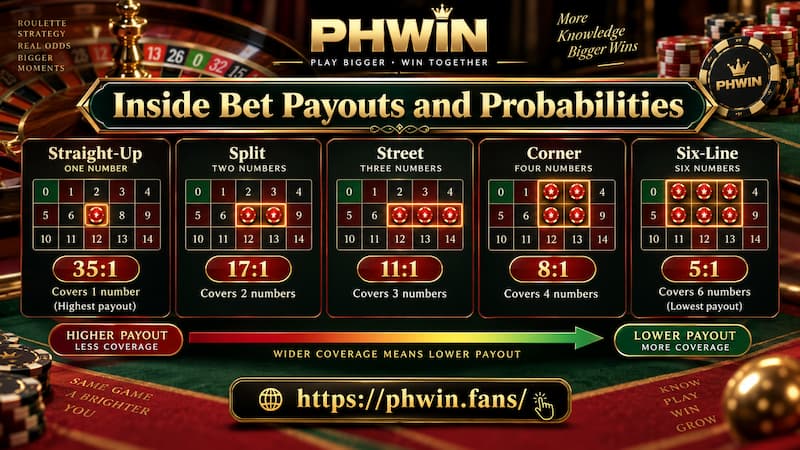
The basic inside-bet structure is built around five wagers: Straight-up, split, street, corner and six-line. As coverage increases, the probability of winning rises while the payout becomes smaller.

The Five Standard Inside Bets
Straight-Up Bet
A straight-up bet covers one number only. Place the chip directly inside the square containing that number.
For example, putting ₱100 on 23 means only 23 can produce a winning result. A standard straight-up win pays 35:1.
That creates a simple trade-off: One number gives you the narrowest possible coverage but the largest standard payout among the regular inside bets.
Zero can also be selected as a straight-up wager on conventional roulette layouts.
Split Bet
A split covers two numbers that touch each other on the grid. The chip goes directly on the line separating them.
Suppose you want 17 and 20. Because those boxes share a border, one chip placed on that border covers both numbers.
A winning split normally pays 17:1.
It is important to choose an actual grid pair. Picking two favorite numbers does not make them a split unless their boxes are adjacent.
Street Bet
A street covers three numbers across one complete horizontal row.
For example:
- 10, 11 and 12
- 19, 20 and 21
- 31, 32 and 33
The chip is positioned at the outside edge of the corresponding row. Standard payout is 11:1.
A street can be useful when you want several consecutive layout numbers without placing three separate straight-up chips.
Corner Bet
A corner covers four numbers that meet at the same intersection.
Take 8, 9, 11 and 12. These four boxes touch around one central point. Placing a chip on that intersection creates one corner bet covering all four numbers.
The standard payout is 8:1.
The intersection is the key. Four unrelated numbers cannot be combined into a corner simply because you want to cover them together.
Six-Line Bet
A six-line bet, often called a double street, combines two neighboring streets for six-number coverage.
A wager covering 13 through 18, for instance, includes:
- 13, 14 and 15
- 16, 17 and 18
The chip sits at the boundary shared by those two rows. A winning six-line wager normally pays 5:1.
Among the five standard inside bets, it offers the widest coverage and therefore the highest probability of landing a winning number on a single chip.
Inside Bet Payouts and Probabilities
The payout figures are easy to memorize, but probability gives them proper context. Roulette does not increase payouts randomly: The return falls as the number of covered outcomes increases.
| Inside Bet | Numbers Covered | Standard Payout | Single-Zero Probability | Double-Zero Probability |
| Straight-Up | 1 | 35:1 | 2.70% | 2.63% |
| Split | 2 | 17:1 | 5.41% | 5.26% |
| Street | 3 | 11:1 | 8.11% | 7.89% |
| Corner | 4 | 8:1 | 10.81% | 10.53% |
| Six-Line | 6 | 5:1 | 16.22% | 15.79% |
A single-zero wheel contains 37 pockets: Numbers 1–36 plus 0. A conventional double-zero wheel contains 38 because 00 is added.
That extra pocket slightly reduces the chance of every standard inside wager winning.
Inside Bet Payouts and Probabilities
A ₱100 Straight-Up Example
Suppose ₱100 goes directly on number 9 and the ball lands on 9.
At 35:1:
- Stake: ₱100
- Profit: ₱3,500
- Original stake returned: ₱100
- Total received: ₱3,600
This distinction matters. A 35:1 payout means 35 times the wager in profit. It does not mean the complete amount returned is only ₱3,500.
A larger payout does not mean a better mathematical bet. It usually means fewer winning outcomes are being covered.
Single-Zero and Double-Zero Tables
Before comparing inside bets, check which wheel is being used.
Single-zero roulette has 37 possible outcomes. Double-zero roulette has 38. Standard inside-bet payouts generally remain unchanged despite the extra 00 pocket, which is why the underlying house edge differs.
On standard single-zero roulette, the house edge is approximately 2.70%. Conventional double-zero roulette raises it to about 5.26%.
There is another detail around the zero area. Some American-style double-zero layouts allow a five-number wager covering 0, 00, 1, 2 and 3. It normally pays 6:1 and carries a higher house edge of about 7.89%.
For that reason, do not assume every group of numbers near zero behaves like a standard street or corner. Check the exact layout before placing the chip.
Inside Bets Compared With Outside Bets
Inside Bets in Roulette concentrate money on small groups. Outside bets spread it across much larger sections of the wheel.
Red or black, for example, covers 18 numbered pockets. A straight-up bet covers one. A six-line covers six.
This changes how a session feels. Straight-up wagers can go through longer stretches without a hit, while broader bets connect more frequently but return less when they win.
However, switching from a straight-up bet to a corner or six-line bet does not automatically create better long-term value on the same standard wheel. For regular wagers, the mathematics behind the wheel remains.
Think of inside-bet selection as choosing the shape of the risk rather than trying to erase it.
Chip Placement Errors
Roulette layouts are compact, and a few millimeters can completely change a wager at a physical table.
Table Adjacency
A valid split follows the printed grid. Wheel neighbors are irrelevant.
For example, 17 and 20 can form a split because their boxes share a boundary. Two numbers positioned next to each other around the wheel may have no legal split connection on the betting layout.
Lines and Intersections
Chip placement determines coverage:
- Center of a number: Straight-up
- Border between two numbers: Split
- End of a three-number row: Street
- Intersection of four numbers: Corner
- Boundary between two streets: Six-line
On live casino roulette tables and other digital versions, highlighted numbers are especially useful. Before confirming a wager, look at which numbers light up rather than relying only on where the chip appears visually.
Total Exposure
Several small chips can quietly turn into a large wager.
Five separate ₱100 inside bets mean ₱500 is exposed on that spin. The fact that every chip is only ₱100 does not make the total stake ₱100. Keeping a fixed session budget and tracking the full amount across all chips are also basic parts of responsible gaming.
At PHWIN or any roulette lobby you use, calculate the full amount on the layout before the betting window closes.
Previous Spins Do Not Change the Next One
A sequence such as 8, 23, 14, 31 and 6 can look meaningful when it appears on a results board. It does not make 17 “due.”
Each standard roulette spin is a new event. A number that has missed 30 consecutive spins does not receive a higher probability simply because it has been absent.
The same applies to hot numbers. Seeing 9 land three times recently does not increase its mathematical chance on the next independent spin.
Results history can be interesting to watch, but it should not be confused with a change in probability.
Matching Coverage to Your Bet
The five inside bets give you different ways to concentrate a wager:
- Choose straight-up when you want one exact number and the highest standard payout.
- Use a split when two adjacent numbers match the coverage you want.
- Select a street for one complete three-number row.
- Place a corner when four numbers share one intersection.
- Use a six-line when you prefer the broadest standard inside coverage from one chip.
None needs to be treated as the universally superior choice. They simply distribute the same wager differently across the numbered grid.
Before committing PHP at PHWIN, check the wheel type, chip denomination, minimum stake, maximum permitted bet and payout shown for that specific roulette table.
Inside Bet Selection Checklist
A disciplined inside wager takes only a few seconds to verify:
- Confirm whether the wheel has 0 only or both 0 and 00.
- Identify exactly how many numbers the chip covers.
- Check the chip’s position on the grid.
- Add every chip to calculate your full stake.
- Confirm the payout for the selected wager.
- Check the table limits before betting.
Inside Bets in Roulette become much easier once chip position, coverage and payout are read together. Straight-up, split, street, corner and six-line bets do not change the basic mathematics of roulette; they change how narrowly or broadly your money is placed across the available outcomes.