



What Low RTP Really Means in Slot Games
Low RTP Slots return a smaller share of total wagers over the long run than comparable higher-RTP games. The goal here is simple: Explain what that percentage means, how it differs from volatility and how to read it before choosing a slot on PHWIN today.
Low RTP Slots and the Number Behind Them
RTP stands for Return to Player. If a slot has a theoretical RTP of 94%, its mathematical model is designed to return about 94% of wagered money over a sufficiently large volume of play. The remaining 6% represents the theoretical house edge.
That sounds simple until someone reads “94% RTP” as “I should get PHP 94 back from PHP 100.” That is not how slot RTP works.
The percentage is measured across large numbers of game rounds. A single session can finish well above the theoretical RTP, far below it or anywhere between. The UK Gambling Commission describes RTP as an average over a large number of games and notes that ordinary game volatility can create substantial differences during individual sessions.
RTP describes the mathematics built into a game. It does not promise a particular result for your next 20, 200 or even 2,000 spins.
Theoretical RTP and Actual RTP
Two figures are easy to confuse.
- Theoretical RTP: The return percentage designed into the game’s mathematical model.
- Actual RTP: The percentage the game has actually returned during a measured period of real wagering.
Actual RTP can temporarily sit above or below the theoretical figure. As the sample of play becomes much larger, the expected range normally narrows toward the game’s theoretical value.
RTP and House Edge
The relationship is direct:
House edge = 100% − RTP.
A few examples make Low RTP Slots much easier to compare:
- 96% RTP = 4% theoretical house edge
- 94% RTP = 6% theoretical house edge
- 92% RTP = 8% theoretical house edge
- 90% RTP = 10% theoretical house edge
PHP 10,000 in Total Wagers
Suppose three games receive exactly PHP 10,000 in turnover.
At 96% RTP, the long-run mathematical difference is PHP 400. At 94%, it becomes PHP 600. At 90%, it reaches PHP 1,000.
Those numbers are expectations across repeated play, not a forecast that a PHP 10,000 session must end at PHP 9,000 on a 90% game.
When an RTP Is Actually Low
There is no universal percentage at which every slot suddenly becomes an officially “low RTP” game. The useful comparison is relative.
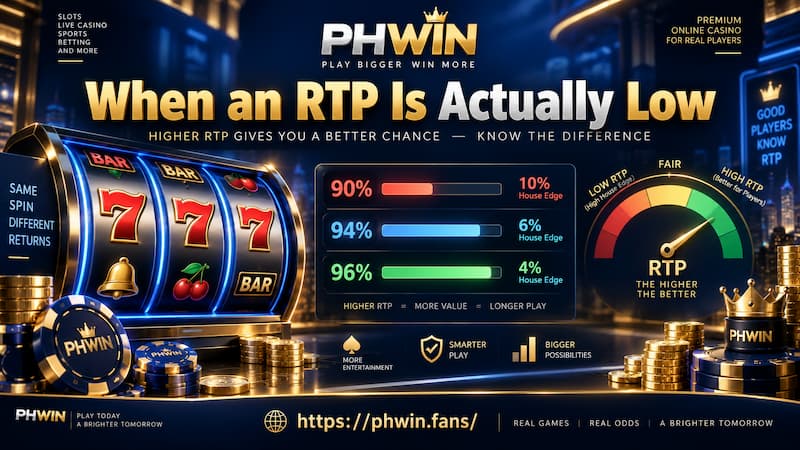
When an RTP Is Actually Low
A 94% game has a lower RTP than a 96% game. A 90% version carries a noticeably larger mathematical edge than either. Whether a number should be treated as low therefore depends on the alternatives available and the exact version being considered.
A one-point gap can look trivial on the information screen. Repeated turnover makes it less trivial.
For every PHP 100,000 theoretically wagered:
- 96% RTP represents PHP 4,000 in expected house edge.
- 94% RTP represents PHP 6,000.
- 92% RTP represents PHP 8,000.
- 90% RTP represents PHP 10,000.
That is a PHP 6,000 theoretical difference between 96% and 90% RTP over the same turnover.
Check the Exact Version
This is especially important with online slots. A familiar game title does not automatically tell you the exact RTP configuration being used.
When comparing games at PHWIN, use the RTP stated inside the specific game whenever that information is provided. An old article, screenshot or general provider description may refer to a different configuration.
The percentage attached to the version in front of you is more useful than a reputation built around the title.
RTP and Volatility Measure Different Things
Low RTP Slots are sometimes assumed to be high-volatility slots. The two concepts are separate.
RTP answers: How much of total wagering is mathematically designed to return over the long run?
Volatility answers a different question: How unevenly can those returns arrive?
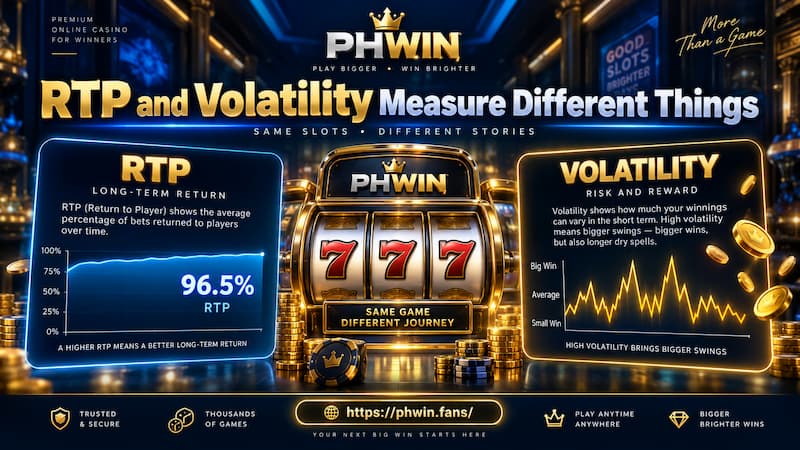
RTP and Volatility Measure Different Things
RTP Measures Long-Run Return
A 96% RTP slot and a 90% RTP slot have different theoretical house edges. That difference exists regardless of whether wins arrive frequently or in rare bursts.
Volatility Measures the Distribution of Results
Higher-volatility slots tend to place more weight on larger, less frequent prizes. Lower-volatility designs generally produce a steadier pattern dominated by smaller, more frequent returns.
The UK Gambling Commission similarly distinguishes volatility from RTP and notes that high volatility produces a wider range of possible actual results over limited samples.
A slot can therefore be:
- High RTP with high volatility
- High RTP with low volatility
- Low RTP with high volatility
- Low RTP with low volatility
Hit Frequency Is Separate Again
Hit frequency tells you how often a spin produces a winning outcome. It still does not reveal how much value those wins return.
Imagine Game A produces a prize on 35% of spins but many wins are smaller than the original stake. Game B hits only 20% of the time but has larger average payouts. Looking at hit frequency alone cannot tell you which game has the higher RTP.
That distinction prevents a common mistake: Equating “I win often” with “this game returns more.”
The Cost of Lower RTP Grows With Turnover
RTP becomes more useful when you stop thinking only about deposits.
A PHP 1,000 deposit is not necessarily PHP 1,000 in turnover. If winnings are repeatedly wagered again, that same balance can generate several thousand pesos of total bets.
The UK Gambling Commission defines turnover as the total of all stakes made on a game, including winnings that are wagered again.
Consider a simple session:
- Start with PHP 1,000.
- Make 100 spins at PHP 20 each.
- Total turnover is already PHP 2,000.
- Continue for another 100 spins and turnover reaches PHP 4,000.
The balance did not need to start at PHP 4,000 for PHP 4,000 to pass through the game.
A Better Way to Compare Low RTP Slots
Instead of asking only, “How much did I deposit?”, compare the theoretical edge against total wagering.
At PHP 100,000 turnover, a 90% RTP game has a theoretical house edge of PHP 10,000. A 96% RTP game has PHP 4,000.
The gap is not caused by one unlucky spin. It comes directly from the six-percentage-point difference built into the mathematics.
Reading RTP Before Choosing a Slot on PHWIN
A slot game thumbnail tells you almost nothing about its return structure. Theme, animations and bonus graphics may catch attention, but RTP sits deeper in the game information.
Before making a comparison, check the available details in a consistent order:
- Find the exact RTP percentage.
- Read the paytable and winning combinations.
- Check whether volatility is disclosed.
- Review the minimum and maximum bet.
- Read the rules for free spins, multipliers and bonus features.
- Check whether the maximum win or progressive jackpot mechanics affect how prizes are distributed.
This keeps several different measurements from being compressed into one vague idea of a “good slot.”
Compare Like With Like
Suppose one PHWIN slot offers 90% RTP with high volatility while another shows 96% RTP with low volatility. The second game has the smaller theoretical house edge, but the difference in session behavior is not caused by RTP alone. Volatility changes how unevenly results may arrive.
Likewise, a streak of 30 losing spins does not reveal the game’s RTP. Neither does one unusually strong bonus round.
RTP is a property of the mathematical model, not a meter that reacts to your recent results.
Philippine RTP Rules and Game Categories
Philippine regulation also shows why RTP percentages should be read in the correct gaming category instead of treating one number as universal.
PAGCOR’s Technical Standards for Electronic Gaming Machines Version 1.1, effective January 1, 2024, specify minimum and maximum percentage requirements of 75% and 98% for EGMs covered by those standards.
Separate PAGCOR rules for electronic gaming use a narrower range for slot-machine-type electronic games. Current regulatory material states an RTP range from 90.00% to less than 97.00% for that category.
Those figures should not be mixed together. An EGM technical standard and an electronic-gaming rule cover different regulatory contexts.
They also do not prove the RTP of any particular PHWIN game. The useful figure remains the percentage disclosed for the exact game and configuration being played.
Low RTP Is a Cost Measure, Not a Prediction
Low RTP Slots carry a larger theoretical house edge than otherwise comparable games with higher RTP. That difference becomes increasingly visible as turnover grows, yet it still cannot tell you whether the next session will finish ahead or behind.
Three checks keep the comparison grounded: Read the exact RTP, separate RTP from volatility and calculate the house edge instead of judging a game by recent wins.
Once those numbers are separated properly, RTP becomes much more useful. It stops looking like a vague percentage buried in the rules and starts functioning as it should: A clear measure of the long-run mathematical cost built into a slot.